By Dr Caroline Noller, Chief Science Officer, Rebuilt
Climate Active is closing. Under the Australian Government’s current proposal, certification ends 30 June 2027, and with it the Climate Active trademarks, consultant register and government-backed certification of carbon neutral claims.
For a scheme that has operated for more than 15 years and given Australian organisations a recognised pathway to measure, reduce and verify their emissions, that is not a small thing to lose.
I understand why it’s happening. The EnergyAustralia settlement exposed a hard truth: offsets do not undo the harm of burning fossil fuels, and carbon neutral claims that obscure that distinction were always going to attract scrutiny.
But I do want to push back on the idea that ending certification rather than improving it was necessarily the best answer.
Steve Ford made this case strongly in The Fifth Estate. His argument is that the scheme could have evolved through tighter boundaries, stronger reduction pathways and greater scrutiny of offset quality rather than being switched off altogether.
And that matters because carbon neutrality was never supposed to mean “offset and forget”.
For many manufacturers, eliminating existing processes, fossil-fuel dependencies or major energy commitments overnight simply isn’t technically or economically possible.
A credible carbon neutral pathway gives those businesses a way to measure the emissions they have today, reduce what they can, transparently address what genuinely remains and keep driving that footprint down.
ISO 14068-1 reinforces that hierarchy, prioritising emissions reduction before offsetting residual emissions.
Carbon neutrality should support decarbonisation, not substitute for it.
The demand for proof isn’t disappearing
Here is my concern.
Net zero was never going to be delivered by government schemes alone. It also needs market incentives that reward the manufacturer who takes the trouble to measure an organisation or product’s actual footprint, reduce it, offset the reaminder where required, and credibly demonstrate the result.
Remove the government-backed certification and you don’t remove the need for that work. Decarbonising the grid and manufacturing processes takes time. And investment and innovation. Offsets put that effort onto the balance sheet. They create the efficiency value proposition.
Customers will still ask for carbon data. Procurement teams and major projects will still require evidence. In building and construction, Green Star, the Infrastructure Sustainability Council’s IS Rating Scheme and NABERS continue to drive demand for verified embodied carbon information.
The badge may be going. The underlying requirements are not.
Businesses still need to:
Measure → Reduce → Address residual emissions → Verify → Communicate credibly
The question is what fills that gap. This is exactly the gap Rebuilt is built to close
At Rebuilt, our mission is to accelerate access to low-cost, rigorous and independently verified carbon assessment, and leave budget for mitigation and and remediation.
We already build Product Carbon Footprints aligned with ISO 14067 and the Greenhouse Gas Protocol, helping manufacturers understand where their carbon sits, identify hotspots and find practical opportunities to reduce it.
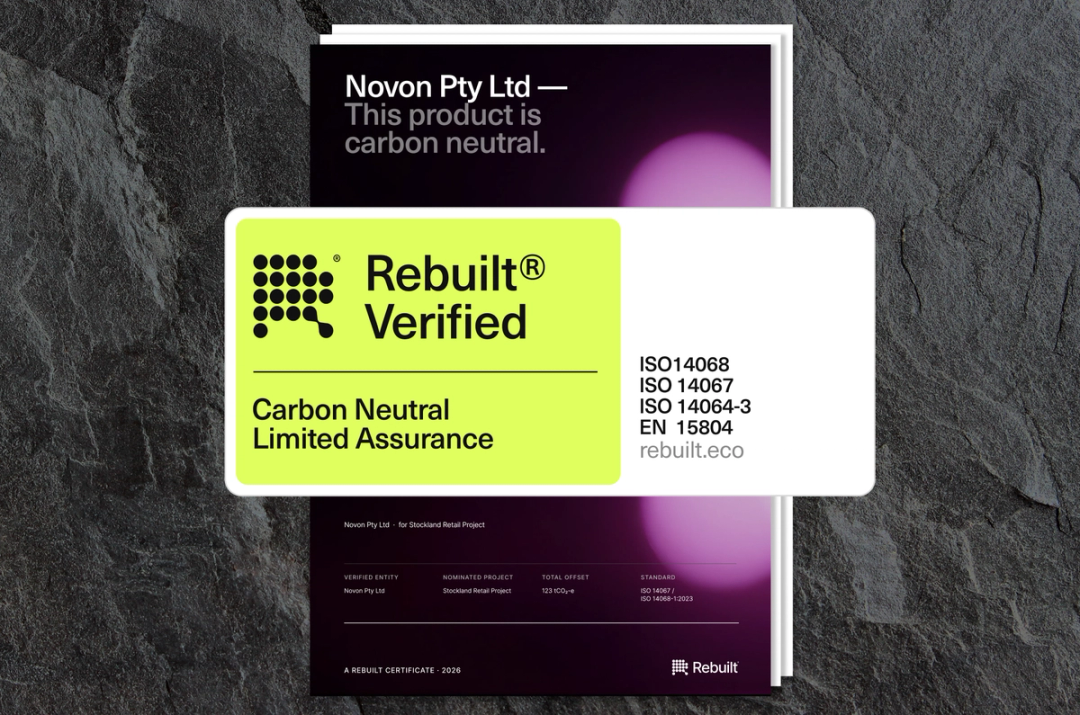
We are now extending that capability to carbon neutrality for products and organisations, using ISO 14068-1 as the internationally recognised pathway for robust and transparent carbon neutral claims.
Rather than treating carbon accounting, reduction, residual emissions and verification as separate exercises, Rebuilt brings them together into one integrated carbon management pathway.
We have already helped Australian manufacturers pursue project-level carbon neutrality to support major developments with carbon certification requirements of their own.
Some dismiss carbon neutrality as greenwash. Poorly substantiated claims can be.
But our experience is that once businesses can actually see and understand the carbon impacts within their operations and supply chains, they naturally start identifying opportunities to reduce them.
Measurement creates visibility. Visibility drives reduction. Reduction enables transition.
Climate Active gave the Australian market more than 15 years of practice at doing this seriously. The scheme is ending. The standard of evidence the market has learned to expect doesn’t have to.
The pathway is changing. The need to measure, reduce and progress at pace isn’t.